
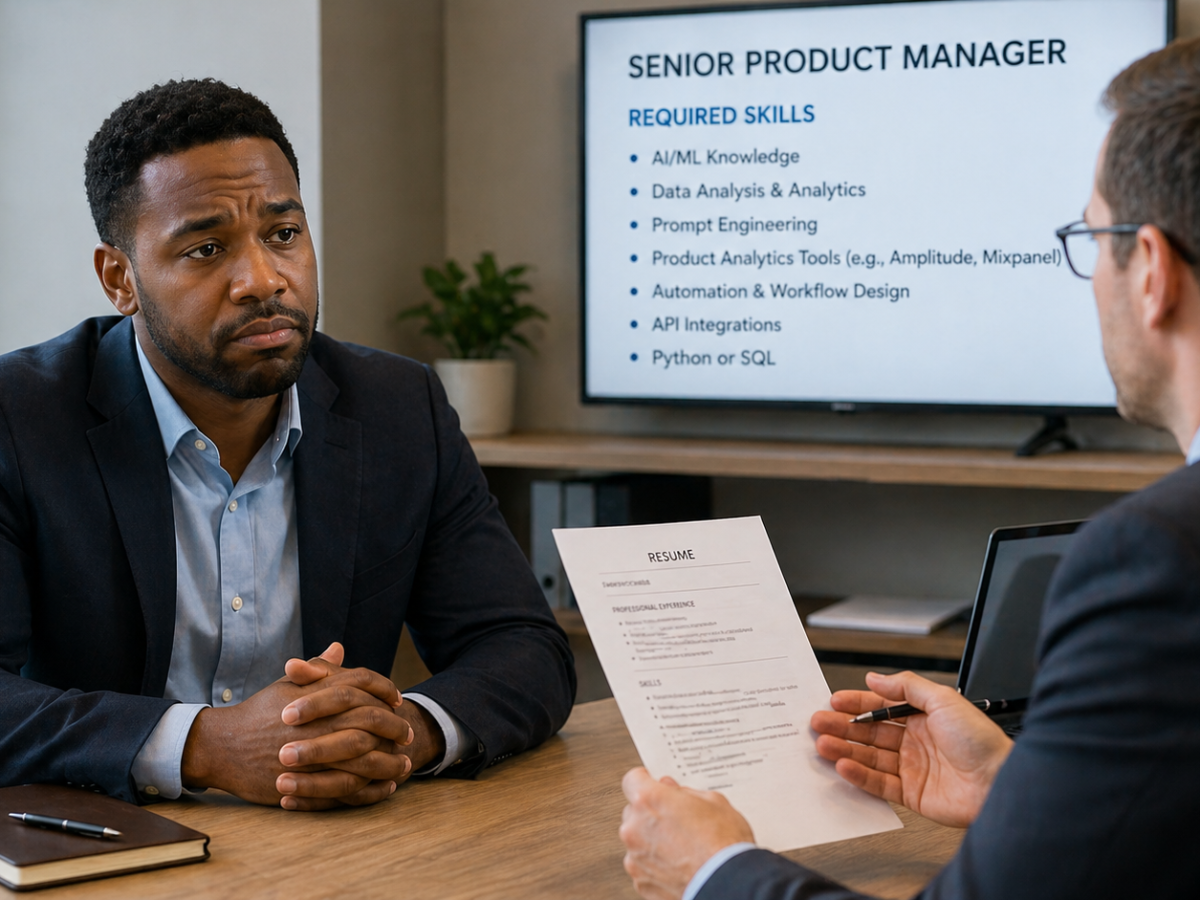

For generations, Black professionals were taught that career success followed a relatively straightforward formula. Work hard, stay loyal, avoid unnecessary mistakes, and eventually the rewards would come. Experience was viewed almost like a savings account. The longer you stayed in the workforce, the more valuable you became. Every additional year was supposed to increase your leverage, strengthen your job security, and move you closer toward financial stability and professional influence.
That belief shaped how many people approached Corporate America. Stability became the goal. Longevity became proof of discipline. Remaining employed and steadily progressing upward was viewed not only as success, but as survival.
The problem is that the labor market has fundamentally changed while many professionals are still operating under rules that no longer exist.
Quietly, companies shifted how they evaluate talent. Entire industries became more technology-driven. Businesses became more aggressive about efficiency, adaptability, and measurable outcomes. The modern economy began rewarding capability faster than tenure, and many professionals did not fully realize the shift until they started watching people with fewer years of experience surpass them financially and professionally.
Today, having five years of experience does not automatically make someone valuable in the marketplace. In many cases, it simply means they have been employed for five years. The distinction between those two realities is becoming more important with every passing year.
The Difference Between Experience and Capability
One of the biggest misconceptions in professional life is the assumption that time automatically creates expertise. In reality, experience only becomes valuable when it produces stronger capability over time. Without growth, experience can easily become repetition disguised as progress.
Two professionals can both claim to have spent five years in the workforce, yet emerge with completely different levels of market value. One employee may have spent those years learning new systems, improving leadership ability, strengthening communication skills, understanding business strategy, and adapting to industry changes. Another may have spent those same years performing the same responsibilities repeatedly without significantly expanding their skill set.
On paper, they look similar. In the marketplace, they are not valued the same way at all.
This is where many professionals unintentionally trap themselves. They begin confusing familiarity with advancement. They assume remaining employed is evidence that they are becoming more competitive, even when their actual capabilities have remained relatively unchanged for years.
Corporate America notices this faster than most people realize.
Companies are not primarily evaluating how long someone has occupied a role. They are evaluating how much economic value that person can create moving forward. Businesses care about problem-solving ability, adaptability, leadership, communication, technical fluency, and strategic thinking because those skills directly influence growth, efficiency, and profitability.
Tenure alone does not.
That is why some professionals are shocked when a younger employee or newer hire commands a significantly higher salary despite having fewer years in the workforce. From an emotional standpoint, it can feel unfair. But the market rarely operates emotionally. It responds to demand.
And right now, demand is heavily centered around relevant skills.
Why Black Professionals Often Get Stuck in This Cycle
For Black professionals, this conversation carries additional weight because many of us were raised around survival-based career advice rather than leverage-based career strategy. Previous generations often had to fight simply to gain entry into professional spaces. Once inside, stability became incredibly important because access itself was never guaranteed.
As a result, many Black professionals were conditioned to prioritize reliability, consistency, and professionalism above all else. The emphasis was often placed on proving competence repeatedly, avoiding mistakes, and becoming indispensable within organizations that did not always create equitable advancement opportunities.
While those strategies helped many people survive and advance, they also created an unintended consequence. A large number of Black professionals became extremely good at performing within systems without necessarily positioning themselves to gain leverage outside of them.
That distinction matters enormously in today’s economy.
Being dependable may make someone valuable internally. Developing highly transferable skills makes them valuable everywhere.
Unfortunately, many professionals spend years becoming operationally essential without becoming strategically mobile. They become the employee leadership relies on during difficult moments. The person who keeps projects moving. The individual everyone trusts to solve problems quietly behind the scenes.
But organizations often reward that type of reliability with additional responsibility rather than increased leverage.
The more dependable someone becomes operationally, the more difficult it can actually become for companies to imagine moving them into larger strategic roles. Over time, many professionals unknowingly become trapped by their own usefulness.
Meanwhile, other employees are spending their energy building skills that increase visibility, mobility, and market demand.
That gap compounds dramatically over time.
The Market No Longer Rewards Loyalty the Same Way
One of the harshest realities professionals eventually confront is realizing that loyalty no longer guarantees protection or advancement the way previous generations expected it to.
There was once a period where long-term commitment to a company often resulted in predictable career progression. Staying at an organization for decades frequently led to stronger benefits, promotions, increased compensation, and a sense of mutual investment between employer and employee.
Modern corporate culture functions very differently.
Today’s companies optimize constantly. Departments restructure regularly. Entire functions disappear overnight due to technology, outsourcing, or changing business priorities. Organizations still appreciate loyal employees, but appreciation does not necessarily translate into long-term security.
This shift has forced many professionals to rethink what career stability actually means.
Ironically, the safest employees in today’s economy are often not the most loyal employees. They are the employees with the strongest market leverage. The professionals who continue receiving recruiter outreach, who possess modern and adaptable skill sets, and who can transition between opportunities without starting over from scratch are the individuals with the greatest long-term protection.
That protection does not come from tenure. It comes from capability.
This is why the labor market increasingly rewards professionals who continuously invest in themselves rather than relying solely on employer recognition to validate their value.

Why Skill Development Has Become Non-Negotiable
The economy is evolving too quickly for passive career development to remain effective.
Technology is reshaping industries in real time. Artificial intelligence is changing how work gets done. Automation is reducing the value of repetitive tasks while increasing the value of strategic thinking, creativity, technical literacy, and communication. Entire career paths are transforming faster than many professionals anticipated.
In this environment, adaptability becomes one of the most valuable professional traits a person can possess.
The professionals thriving right now are rarely the ones assuming their existing experience will carry them indefinitely. They are the people aggressively learning new tools, understanding emerging trends, strengthening adjacent capabilities, and positioning themselves ahead of where the market is moving.
That does not mean everyone needs to become a software engineer or technical expert. But it does mean professionals must become intentional about staying relevant.
Companies are increasingly paying premium salaries for people who can solve difficult business problems, lead effectively across teams, communicate clearly, understand technology, interpret data, drive revenue, and adapt quickly to change. Those skills create measurable value, which is why organizations compete aggressively for them.
Meanwhile, employees who rely exclusively on past experience without continuously evolving often find themselves vulnerable when industries shift or opportunities tighten.
The uncomfortable reality is that many professionals are not underpaid because they lack intelligence or work ethic. They are underpaid because their current skill stack does not create enough leverage in the modern market.
That reality can feel frustrating, but it is also empowering because skills are developable.
Reframing Career Growth Entirely
One of the most important mindset shifts professionals can make is learning to view their career as an evolving asset rather than a static destination. Employment should not be treated as proof that growth is happening automatically. Career development has become increasingly self-directed, and the professionals who understand this early position themselves very differently over time.
That means asking harder questions regularly.
Am I becoming more valuable every year?
Are my skills transferable beyond my current employer?
Would companies compete for me if I entered the market tomorrow?
Am I building expertise that aligns with where the economy is going rather than where it has already been?
Those questions matter because they force professionals to think strategically instead of emotionally about career progression.
Many companies are perfectly comfortable allowing employees to remain stagnant as long as the work continues getting done. Organizations prioritize business outcomes, not necessarily long-term employee marketability. That means professionals must take ownership over their own growth rather than assuming employers will naturally guide them toward future relevance.
For Black professionals especially, this shift toward intentional skill development creates a different kind of leverage. While stronger capabilities do not eliminate bias or structural inequality, they do create mobility, flexibility, and optionality that become increasingly difficult for organizations to ignore.
And options change everything.
The Professionals Who Win Will Think Differently
Ultimately, the labor market is forcing professionals to separate effort from value in a way that previous generations did not have to confront as aggressively.
Working hard still matters. Professionalism still matters. Reliability still matters. But those qualities alone are no longer enough to guarantee advancement or financial growth.
The professionals who thrive over the next decade will be the individuals who continuously expand their capabilities alongside changing market demands. They will be the people who treat learning as an ongoing responsibility rather than a temporary phase early in their career.
Most importantly, they will understand that experience only matters when it produces stronger positioning over time.
That is the real difference between simply accumulating years and actually building value.
And in today’s economy, the market knows the difference immediately.